

JUNE – what to look out for
June is the month when the meadows and verges are full of flowers and the breeding season for the birds is in full swing. The emergence of butterflies, damselflies and dragonflies is also in full swing.
On the Pools
 |
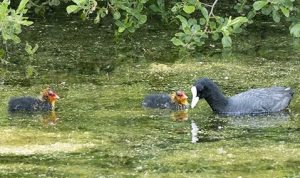 |
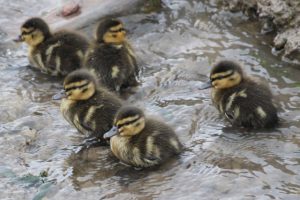
The birds of both the North and South Pools are busy hatching and raising young. If you look carefully from the hides, you might see young Coots, Moorhens and ducklings out on the water. When Lesser Black-backed Gulls and Oystercatchers nest on the islands their young should have hatched out. The Oystercatchers’ chicks are especially vulnerable until they can fly.
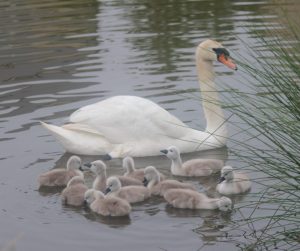
Look out for swans and cygnets in the Ecology Park ponds and please keep your dogs well clear while in this area.
Did you know there is a Public Space Protection Order in place here banning dogs from the water? This means it is a criminal offence to let your dog in the water . . . and anyway who wouldn’t want to make sure the swans and cygnets and other wildlife stay safe!
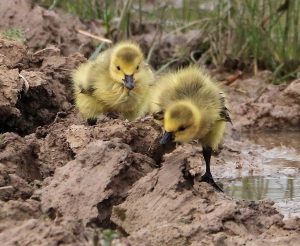
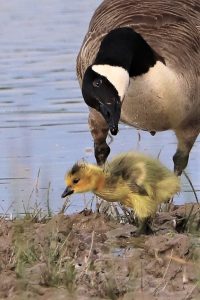
Meanwhile on South Pool you might be lucky enough to spot Canada Geese goslings like these photographed by Michael Brighton . . .
  |
In the Hedgerows and Rhynes
Some of the birds to LISTEN out for in June
Once the leaves are on the trees you are more likely to hear the birds in the hedgerows than to see them. Most birds are busy raising young, but they still pause to mark out their territories with song in the early morning and again in the evening. The middle of the day can be quite quiet, especially if it gets hot.
Common Whitethroat
In brambly areas the Common Whitethroat will be singing its short scratchy tune, sometimes delivering it in a display flight above the bushes.
Lesser Whitethroat
Its more secretive cousin, the Lesser Whitethroat, has a song which is just a tuneless rattle, often coming from the middle of a bush.
Reed Warbler
Also very distinctive is the Reed Warbler song, which you will hear along the rhynes. It is a long, drawn-out chugging and churring song, but often has quite a bit of trilling and whistling.
Cetti’s Warbler
The loudest and most explosive song must come from the Cetti’s Warbler. These birds can be right beside you hidden in the hedge and the sudden outburst of song can almost make you jump! Listen here . . .
Some of the DAMSELFLIES and DRAGONFLIES to look out for in June
The small damselflies can be seen everywhere at this time of year. Most species are blue, like the Azure Damselfly and they are very difficult to tell apart.
The dragonflies are much larger and faster flying and can be very colourful. Two species you are quite likely to see along the ryhnes and ditches in June are the Four-spot Chaser and the Emperor Dragonfly.
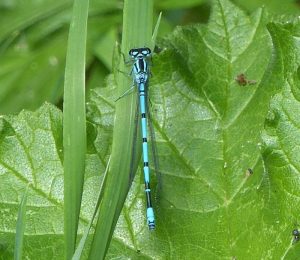 Azure Damselfly Azure Damselfly |
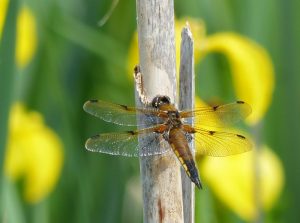 Four-spot Chaser Four-spot Chaser |
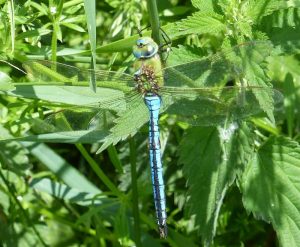 Emperor Dragonfly Emperor Dragonfly |
Damselfly and dragonfly photos by Giles Morris
We hope you see, or hear, some of these creatures the next time you visit the reserve.

Nice summary! Thanks for saving me hours of research.